QuantumCat/Features/Option chain
Option chain · 11 of 18
A chain you can trade from.
Greeks off the chain’s own IV, OI change measured from the previous close, depth to the level your broker actually serves — and every structure buildable straight off the ladder.
Option chain0:19 · narrated · real build
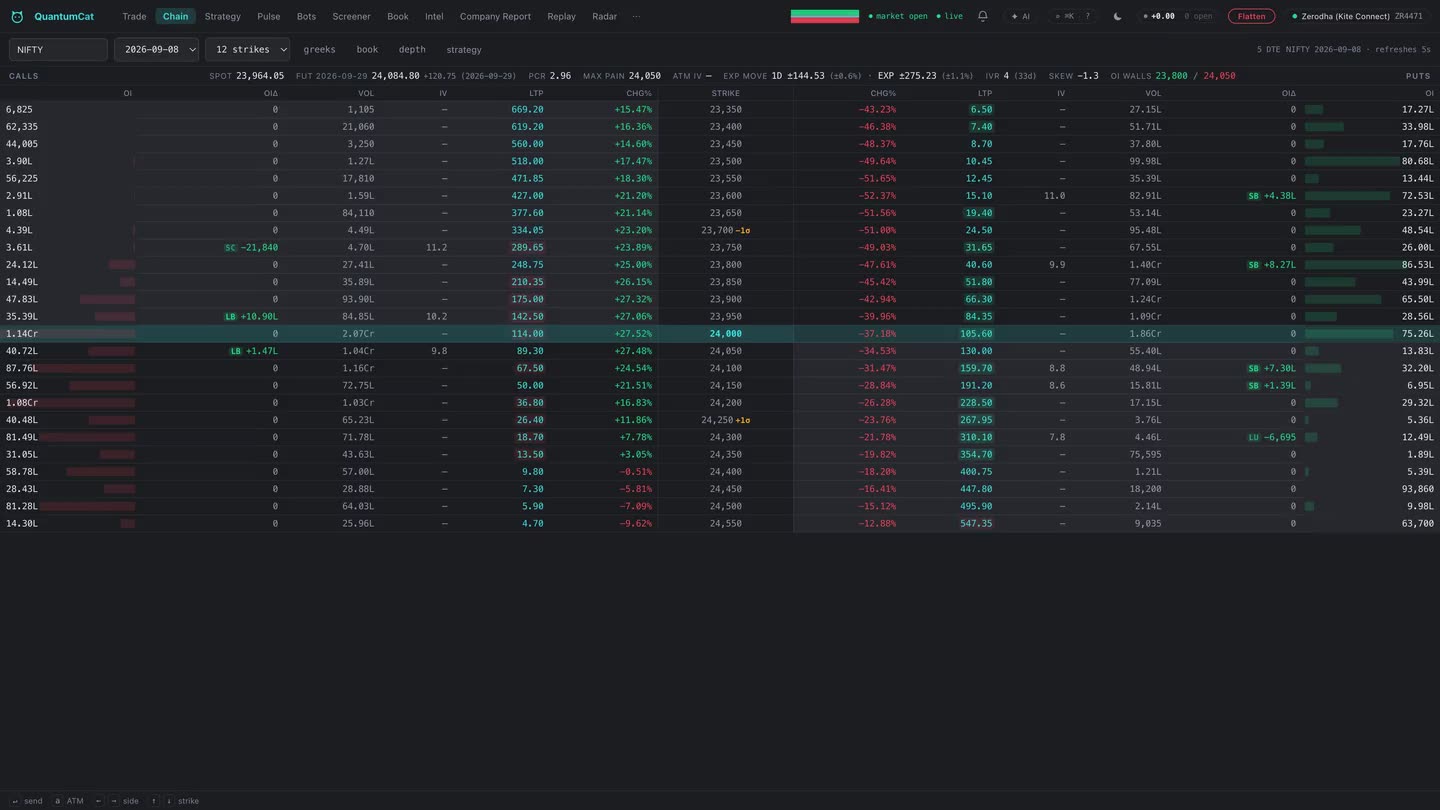
The chain is a working surface, not a wall of numbers
Every strike carries the values you actually decide on — LTP, bid/ask and the spread, OI and the change in OI since the previous session’s close, volume, IV, and per-strike Δ/Γ/Θ/vega — and the whole ladder updates off your own broker’s tick feed. Click any cell to send that contract to the ticket, the chart, or a payoff leg. Greeks are computed with Black-76 off the chain’s own IV, so they agree with the premiums beside them rather than a textbook curve.
Three views of the same ladder
| View | What it swaps in |
|---|---|
| Flow | The default: OI, ΔOI, volume and IV per strike — where positions are actually being built. |
| Greeks | Δ/Γ/Θ/vega per strike, theta shown per day and vega per vol-point, so the numbers are in units you can size against. |
| Book | Best bid, best ask, absolute spread and spread as a percentage of mid — the liquidity read that decides whether a strike is tradeable at all. |
Depth, to the level your broker actually serves
The depth rail shows the 5×2 ladder on every broker, and the 20×2 ladder where the broker’s own metadata says it serves one — Dhan, on NSE and NFO today. It is never faked: on a broker or segment without 20-level depth the toggle is disabled and says why, rather than padding five levels into twenty. Each side is tracked independently, so a one-sided depth push is visible as exactly that.
Expiry day gets its own panel
On expiry, the panel narrates only what it measured from chain deltas: OI migration between strikes, max-pain drift through the session, and the gamma-flip level. It is descriptive by design — it tells you where positions moved, not what to do about it. Nothing on it is a recommendation.
Build the structure while you read it
Option-click a strike to add a short leg, click to add a long one, and the payoff panel draws the structure as you go — breakevens, max profit and loss, the full charge stack, and the greeks of the assembled position. Ready-made structures (verticals, straddles, strangles, butterflies, iron condors) drop in as legs you can then move. The whole basket goes to the order engine as one unit, with the freeze-quantity and lot-size rules already applied.
Honesty rules on the chain
- An unpriced strike shows “—”, never ₹0.00. A contract quoted but not yet traded today has no LTP; printing zero in the premium column reads as a real price, so the cell abstains and says why on hover.
- ΔOI is measured from the previous session’s close, seeded before the ladder opens — not from whenever you happened to open the chain.
- A cold quote never fakes a day-change. If the backend has no snapshot base for a strike, its absolute OI is not presented as an OI change.
- Expiries come from the instrument master, so the list is correct before any broker session exists — but the premiums need a live session, and the panel says so instead of spinning forever.
On the real build