QuantumCat/Features/Intel
Market Intel · 06 of 18
Who’s behind the move, and what’s scheduled to hit it.
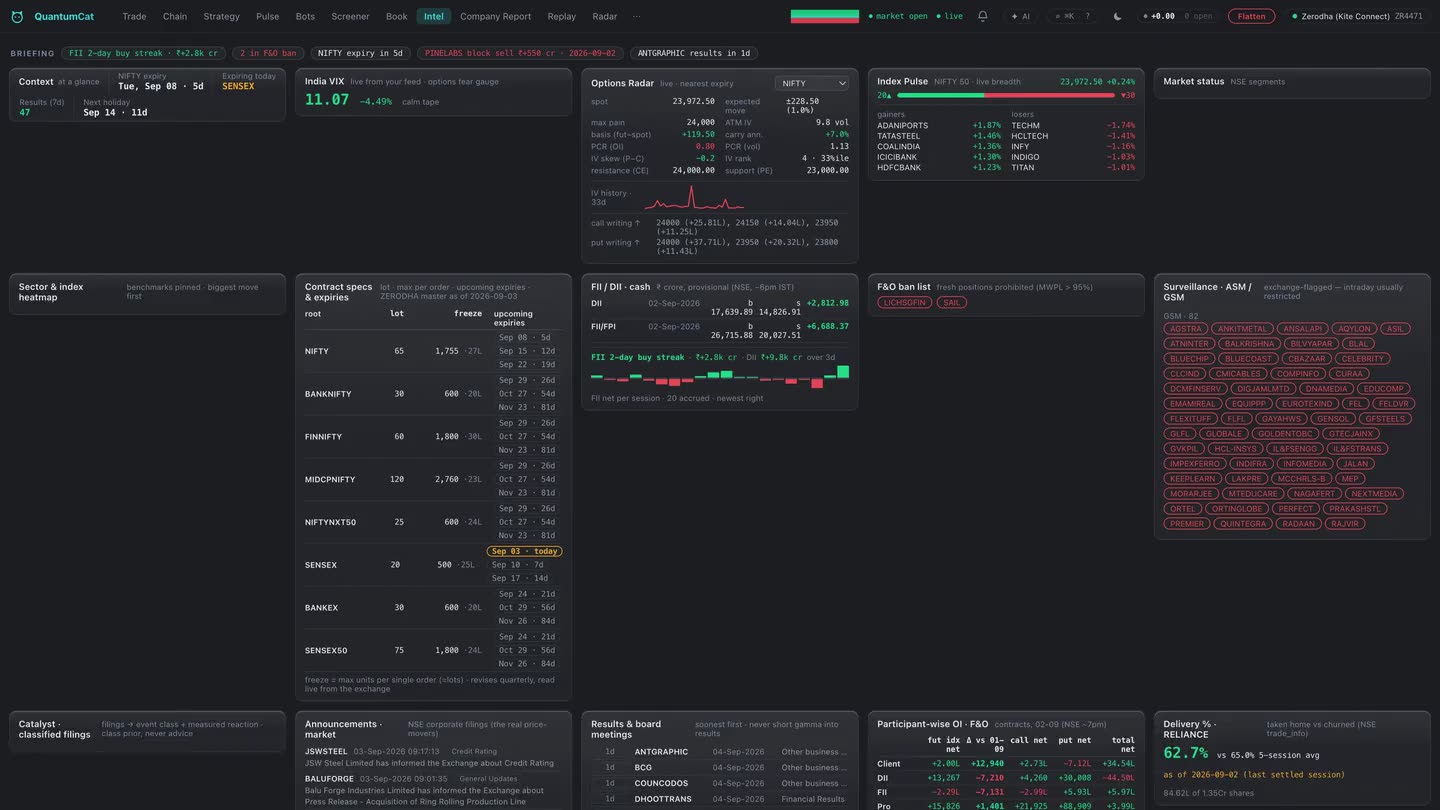
FII/DII flow streaks, options radar with self-accumulated IV rank, index breadth and sector rotation, events calendar — the context layer, one view from the ticket.
The context layer beside every trade
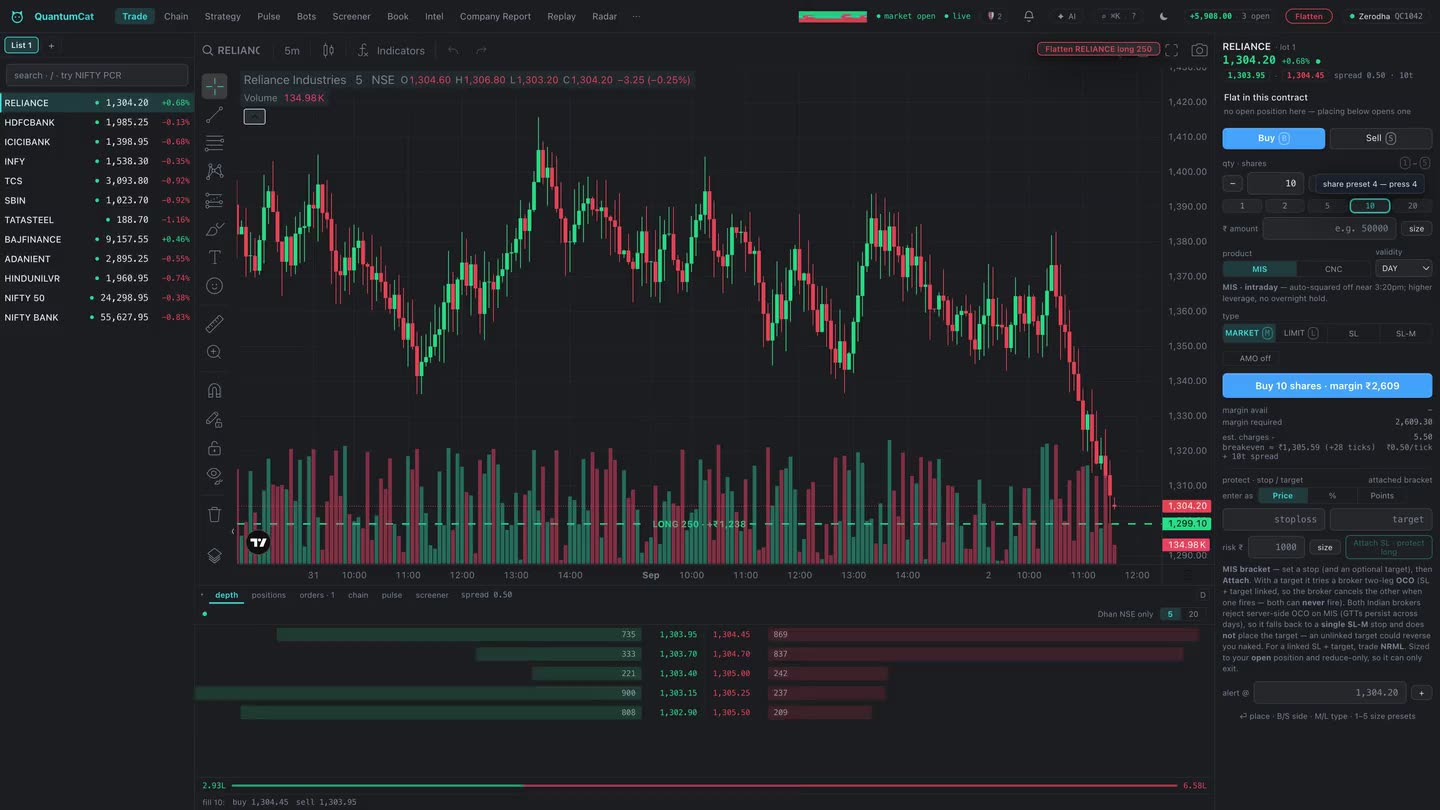
Price tells you what happened; Intel tells you who was behind it and what’s scheduled to hit it next. Everything below sits one view away from the ticket, sourced from official archives and your own broker feed — no scraped tips, no delayed reposts.
Institutional flows — FII & DII
Daily foreign (FII) and domestic (DII) institutional cash-market buying and selling, accumulated day by day into your own local archive, with streak detection: how many consecutive sessions each side has been net buying or selling, and how today compares to the run. The same series feeds SwingPulse’s institutional-flow trail, and FII index-futures positioning drift is tracked separately — cash flows tell you conviction, derivatives positioning tells you hedging and leverage.
Why it matters: institutions deploy over days, not minutes. A five-session FII selling streak is a different market to trade than a two-day DII absorption of the same selling — and neither is visible on a candle.
Options radar
- IV rank & history — today’s ATM implied volatility ranked against its own self-accumulated archive, per underlying: is premium rich or cheap for this name? With a sparkline of where IV has been.
- Writing build-ups — where call and put open interest is stacking, read as support/resistance the options market is underwriting.
- PCR, max pain, OI walls — computed over the full ladder (never just the visible window), and never faked: a chain with no real OI shows no max-pain instead of a fabricated one.
Index pulse & sector heat
Live breadth for NIFTY and BANKNIFTY — advancers vs decliners among constituents, the day’s real gainers and losers, and which names are dragging or carrying the index now. Beside it, a sector heatmap of the session so rotation is visible at a glance. No fake index weights: the movers are computed from live constituent ticks on your own feed.
Market status, calendar & corporate actions
Session state (pre-open, open, closed, holiday) per segment, upcoming holidays, scheduled results and corporate actions/events for the names you hold or watch — the same events calendar that gates SwingPulse confidence inside an earnings window.
Quote-consistency radar — now its own screen
A detector that watches the option chain for internally inconsistent pricing — parity violations, quotes below intrinsic, spreads outside their own arithmetic bounds — and journals every card with the evidence, then grades itself: did the inconsistency survive 30 seconds? Was it still fillable? The scorecard is on screen, in observe mode by default. It is a microstructure research instrument with its own honesty ledger, not an arbitrage promise.
It used to be a card bolted to the bottom of this page while its switches and thresholds lived in Settings, so tuning it meant changing a number here and checking the result somewhere else. It is its own surface now, with the controls beside the evidence and each detector’s measured record beside its switch.
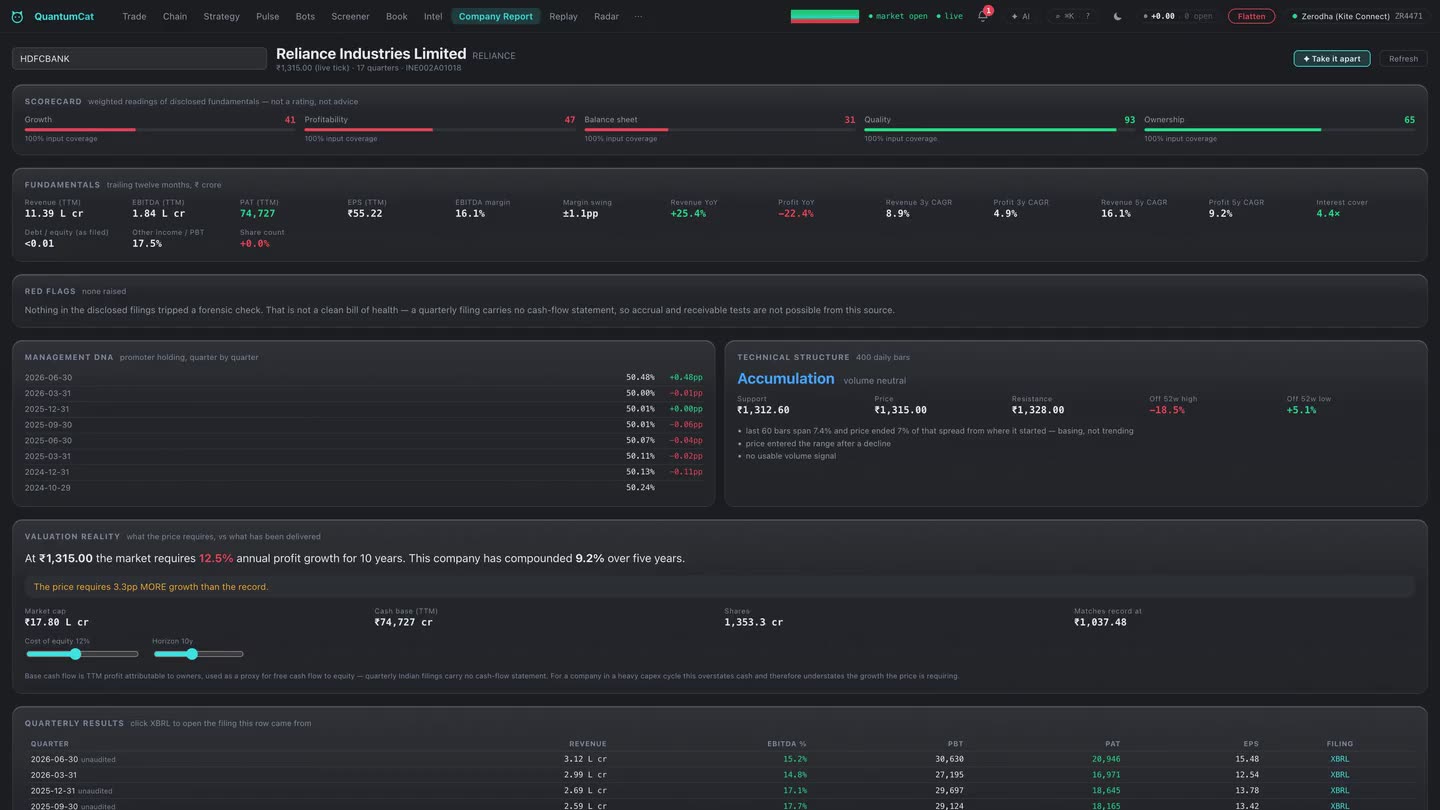
The other screen one step from here is the Company Report — the same NSE filings that feed the events calendar above, taken apart into five scored pillars, forensic red flags with their evidence attached, and a reverse DCF that prices the expectation already in the stock. It is what the capture at the foot of this page is showing.
On the real build