QuantumCat/Features/Investing
Investing · 08 of 18
Research candidates, with their reasons.
Seven explicit rules run over a universe you choose, each candidate shown with the numbers that made it qualify and how much of the universe the pass could actually judge — plus an explorer that turns one list into a whole-share model allocation for a real budget.
Morning forecast and rotation0:38 · narrated · real build
Research candidates with their reasons — never recommendations
Investing is the terminal’s starting point for money you are not trading today: seven explicit rules run over a universe you choose, each candidate shown with the numbers that made it qualify, and a guided explorer that turns one of those lists into a whole-share model allocation for an actual budget.
Nothing here ranks the market or tells you what to own. Every list carries its rule, its scan time, the price basis it was priced on, the universe it evaluated and how much of that universe it could actually judge — so a partial pass reads as a partial pass, never as a verdict.
Seven rules, one engine
Growth, Value, Income, Lower volatility, Quality, Trend leaders and Pullbacks are scanned through the same screener engine the Screener runs — not a second implementation that can drift from it. The rules are written out, and you can edit them.
Each rule reports on two horizons kept separate rather than blended: long-term, months to years, and short-term, days to weeks.
Why one engine matters: if the Investing list and the Screener disagree about whether a stock passes the same test, one of them is lying and you cannot tell which. There is one condition evaluator in the app, and the bots and the backtester use it too.
The universe is yours to set
- NIFTY 50 or NIFTY 500, resolved on your signed-in broker’s own instrument master.
- Your watchlist, whatever is on it today.
- A custom list of up to 300 names, written as exchange-qualified references across NSE and BSE — so a BSE-only name is scanned as a BSE name, and never quietly matched to a different company that shares the ticker on the other exchange.
Every list states the universe as the scan actually saw it: “NIFTY 500 · 497 names resolved” is a different fact from “NIFTY 500”, and the difference is on screen.
Every row shows its own arithmetic
- The scanned number against the threshold it had to clear — not a tick, not a star rating.
- When it was scanned, and on what price basis.
- What changed since the previous completed pass — what entered the list, what left it — diffed against the retained previous scan rather than recomputed from memory.
- The latest filed results for a candidate, expanded in place from the exchange’s own filings for that exact company on that exact venue.
- Upcoming events for the next thirty days, joined to your own exposure — the results and corporate actions that are scheduled to hit what you already hold.
A candidate can be added to your watchlist straight from its row, resolved on the broker you are signed in to before anything is written.
The portfolio explorer
A four-step guided flow that answers a question a screener cannot: given this much money, what would this list actually look like as a portfolio?
- Budget. The rupees you are modelling, entered by you.
- Style & constraints. Which rule, which universe, and the limits the plan has to respect.
- The model allocation. Whole shares inside the budget — never fractional pretend positions — weighted by the rotation engine’s own weighting, costed from the same charge table the rest of the app uses, and editable.
- Review. The plan set against what you actually hold today, position by position.
The prices are live, and the explorer says so. A preview, a save or a recompute runs the chosen style’s rule over the universe on your signed-in broker at that moment — a fresh sweep, never the Ideas tab’s retained scan. That is why it needs a session, and why it refuses rather than quietly reusing an older scan’s prices.
Plans can be saved as scenarios, kept privately with the exact plan you reviewed, and compared against each other.
Exploration is separate from execution
Nothing in Investing places an order. The single bridge to trading is deliberate and narrow: Track on paper writes the allocation into Bots as a rotation strategy in paper mode, which you then start there, through that view’s own review and start controls. Two surfaces, two decisions, and the second one is a human pressing a button.
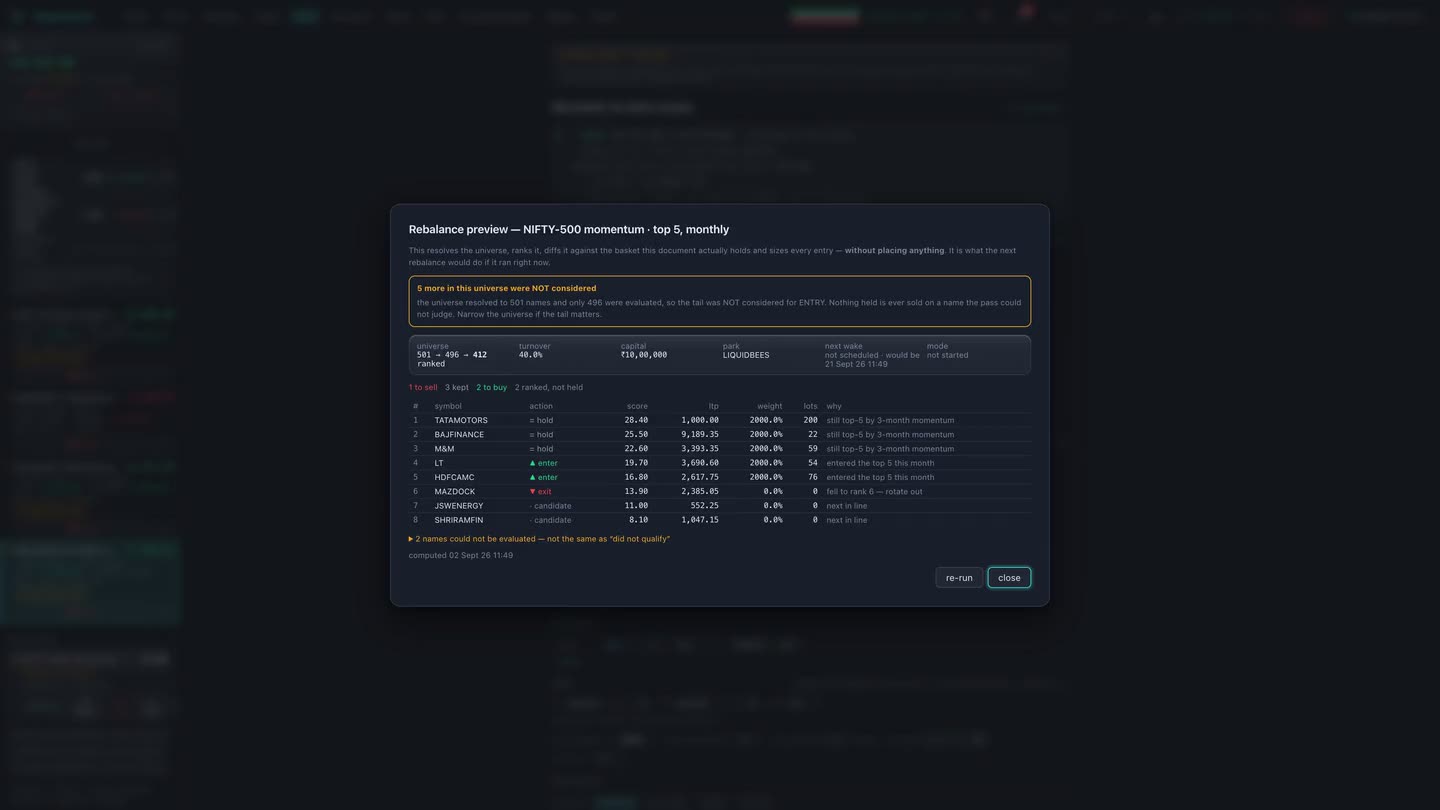
That destination is what the clip on this page shows: a rotation’s rebalance preview in Bots, resolving the universe, ranking it, and stating the difference against what is actually held — without placing anything. It counts the names it could not evaluate separately from the names that did not qualify, for the same reason every list in Investing does. The narrated chapter is from the same recording; the Investing view itself is newer than the film, and the walkthrough will be re-cut with it.
What Investing is not
It is not advice, a model portfolio, a tip list or a ranking of the market. It is a rule you can read, run over a universe you chose, with the numbers that made each name qualify printed beside it — plus the honest statement of how much of that universe the pass could actually evaluate. Filed numbers can be late or restated, a scan is a snapshot of one moment, and a rule that worked before is not a promise. What you buy, and the risk you take, are yours.